
The European Union’s Packaging and Packaging Waste Regulation (PPWR) marks an important step towards greater sustainability and sets high demands for food manufacturers.
From 2030 onwards, all packaging in the EU must be recyclable – a major challenge, especially for sensitive products such as cookies, chocolate-coated products, or frozen foods, for which product protection is essential. Packaging must resist moisture, grease, and mechanical stress during transport while preserving flavor. Alternative materials such as paper or mono-material often make this more difficult, leaving food manufacturers walking a tightrope: they must make packaging more sustainable without compromising on product protection and shelf life.
In addition, the PPWR calls for a reduction in packaging material to minimize waste. Many manufacturers, however, face technical issues, as existing production lines are often not designed to handle alternative materials. At the same time, they must make sure that their production processes remain efficient and profitable. Switching to sustainable packaging therefore often requires adjusting the material, as well as the equipment, processes, and supply chains. To find an economical and sustainable solution, manufacturers need expert guidance and support.
Working together for sustainability
This is where Syntegon comes in – as a strategic partner working closely with manufacturers to develop customized packaging solutions that meet both regulatory requirements and specific customer needs. In addition to innovative technologies, Syntegon offers comprehensive consulting and tailored services – from material testing to retrofits. The goal is to co-create future-ready solutions that boost production efficiency and already meet PPWR requirements today.
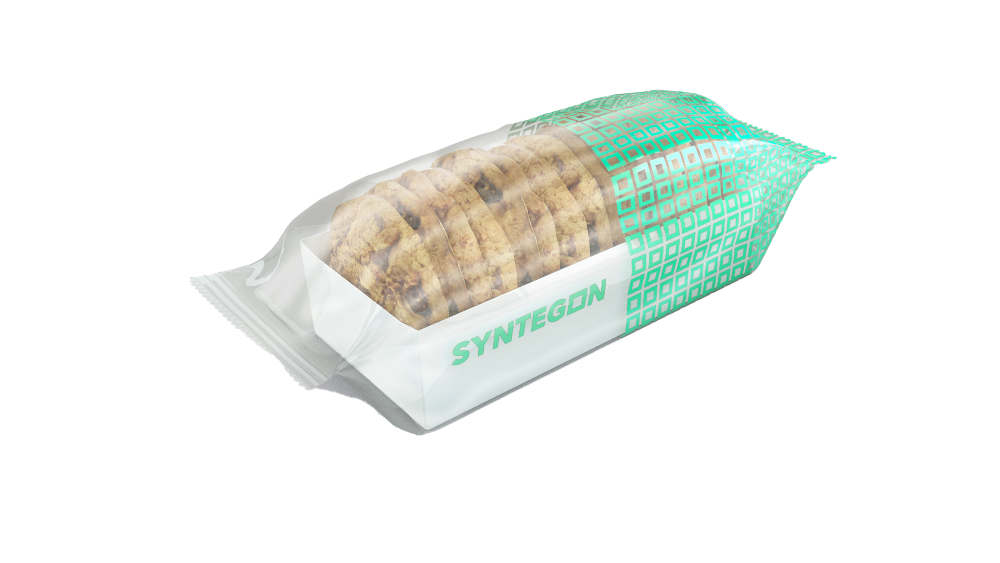
Cookie packaging can serve as an example. Together with Syntegon, manufacturers are replacing non-recyclable plastic trays with glue-free cardboard alternatives. The lockstyle technology on Syntegon’s topload cartoners – which was developed by the Syntegon subsidiary Kliklok – reduces glue consumption to zero. This saves resources, simplifies the production process, and creates 100 percent recyclable trays. Although the trays are wrapped with a thin mono-material film to ensure product protection, plastic use is reduced by around 35 percent.
“With our cardboard trays, cookie producers can make their packaging more sustainable: less plastic, no glue, and just as safe – the ideal solution.”
Stephan Schuele, Director of Strategy and Product Management Food Horizontal at Syntegon
Less material consumption thanks to recyclability and higher efficiency
Flow-wraps made from paper are another future-oriented solution. They are suitable for both primary packaging and multipacks and are produced on horizontal flow-wrap machines equipped with the innovative paper-ON-form module. This makes them a fully recyclable alternative to plastic films, allowing manufacturers to significantly reduce plastic consumption without compromising on quality.
Syntegon also supports food manufacturers with comprehensive expertise in vertical packaging. When it comes to frozen foods like vegetables or ready meals, switching to sustainable materials presents even greater challenges: the packaging must be freezer-safe, puncture-resistant, and fully recyclable.
With the PHS 2.0 sealing system, Syntegon offers a solution that meets these requirements and saves up to 50 percent material. It seals very thin mono-material films (BOPE) reliably, reducing film thickness from the typical 30 to 80 micrometers to only 20 micrometers. In addition to lowering plastic consumption, manufacturers also benefit from longer film rolls, which need to be changed less frequently, thereby minimizing downtime. Despite the thin material, the system ensures consistently high sealing quality – and even enables higher speeds. Manufacturers can increase their output by up to 25 percent and reduce costs by up to 30 percent – an important lever for meeting PPWR requirements without sacrificing efficiency or product integrity.
With technologies like these, customers can easily switch to resource-saving packaging that combines reliable performance and economic efficiency. As a strategic partner, Syntegon supports them in turning the goals of the PPWR into tangible results.
“We can only achieve sustainability together. We support our customers with tailored solutions that combine environmental responsibility with long-term competitive strength.”
Martin Boutkan, Product Manager VFFS Technology at Syntegon
Energy-efficient production in the pharmaceutical, biotech, and food industries
Alongside measures to improve its own sites and business activities, Syntegon also helps its customers achieve greater energy efficiency and save resources in their production operations.
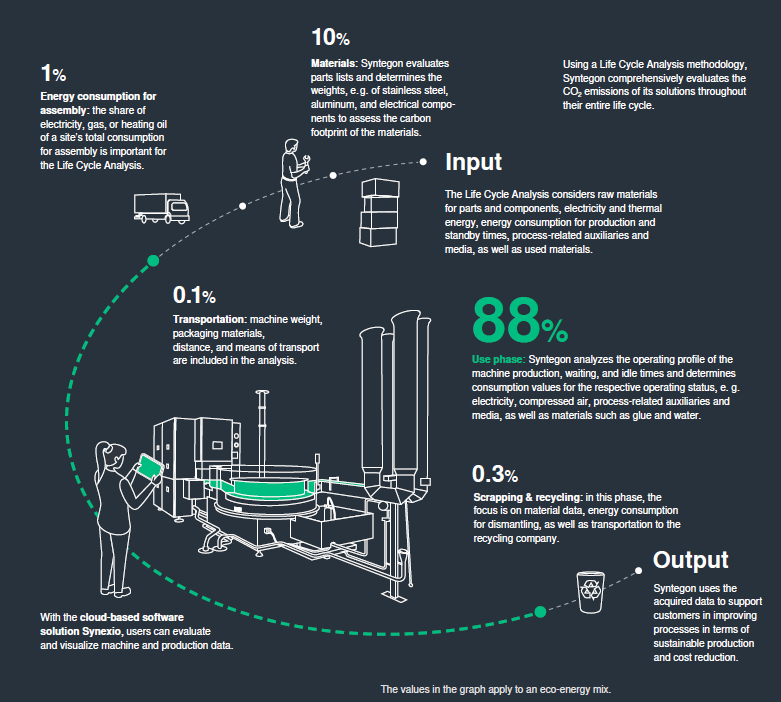
Syntegon’s smart and sustainable solutions are designed for maximum resource conservation and enable companies to process packaging materials with minimal energy input. Using a Life Cycle Analysis, the company evaluates the CO₂ equivalent for its solutions in terms of their material and energy consumption over the entire life cycle. This data helps Syntegon continuously optimize its portfolio and thereby further reduce the overall consumption of resources (see also illustration on the right).
The energy a technology consumes across its entire life cycle is a key factor. Over two-thirds of its product carbon footprint is generated during service life. The company therefore aims to reduce the consumption of energy-intensive equipment.
In the course of target validation by the Science Based Target initiative (SBTi), Syntegon has revised its goals for emissions reductions. Over the period from 2022 to 2030, the company is now aiming to achieve a 25 percent reduction in absolute Scope 3 emissions arising from purchased goods and services and from the use of sold products.
Syntegon started at an early stage to help its customers make their production processes more sustainable. The company’s integrated approach includes not only efficient manufacturing equipment, but also a comprehensive service portfolio, including spare parts management, machine retrofits, and digital enhancement of overall system efficiency. In this way, Syntegon is able to extend the service life, efficiency, and availability of its machines.
Syntegon Newsletter
Get inspired with regular updates on technologies and services, case studies, webinar offers and events.