Pharmaceutical, biotech, and food producers are currently facing a twofold challenge: maintaining the highest quality standards while reducing their carbon footprint.
In the pharmaceutical and biotech industries, strict clean room requirements and energy-intensive processes like sterilization at high water temperatures are increasing consumption. In the food industry, production steps like cooking and cooling cause most emissions. Regulatory pressure to develop new sustainable packaging solutions is another factor. Many manufacturers are therefore systematically gearing their strategies towards reducing emissions – and are finding a partner with similar goals: Syntegon.
Sustainability is not just a buzzword for Syntegon, but an integral part of the corporate strategy – delivering measurable benefits for customers. With ambitious climate targets validated by the Science Based Targets initiative (SBTi) in 2024, Syntegon is committed to significant emission reductions. The focus is not only on the company’s own CO₂ footprint, but above all on more efficient machines for customers. The more resource-efficient Syntegon’s solutions are, the more pharmaceutical, biotech, and food manufacturers can save on both emissions and operating costs.
The scientific development of sustainable solutions is a key driver for Syntegon, both for the company’s own strategy and for that of its customers. Leon Eiler, who is responsible for SBTi at Syntegon, and Steffen Carbon, coordinator for development methods, work closely together to turn climate targets into practical results.

“Only if we can provide a clear data basis to back up our resource efficiency can we achieve sustainable improvements in the long term.”
Leon Eiler, Sustainability Manager at Syntegon
“We develop technical innovations that reduce energy consumption and focus on real reductions rather than CO₂ compensation – through efficiency gains, lower-emission materials, and the use of renewable energies along the value chain.”
Steffen Carbon, Coordinator for development methods at Syntegon
Tangible climate targets
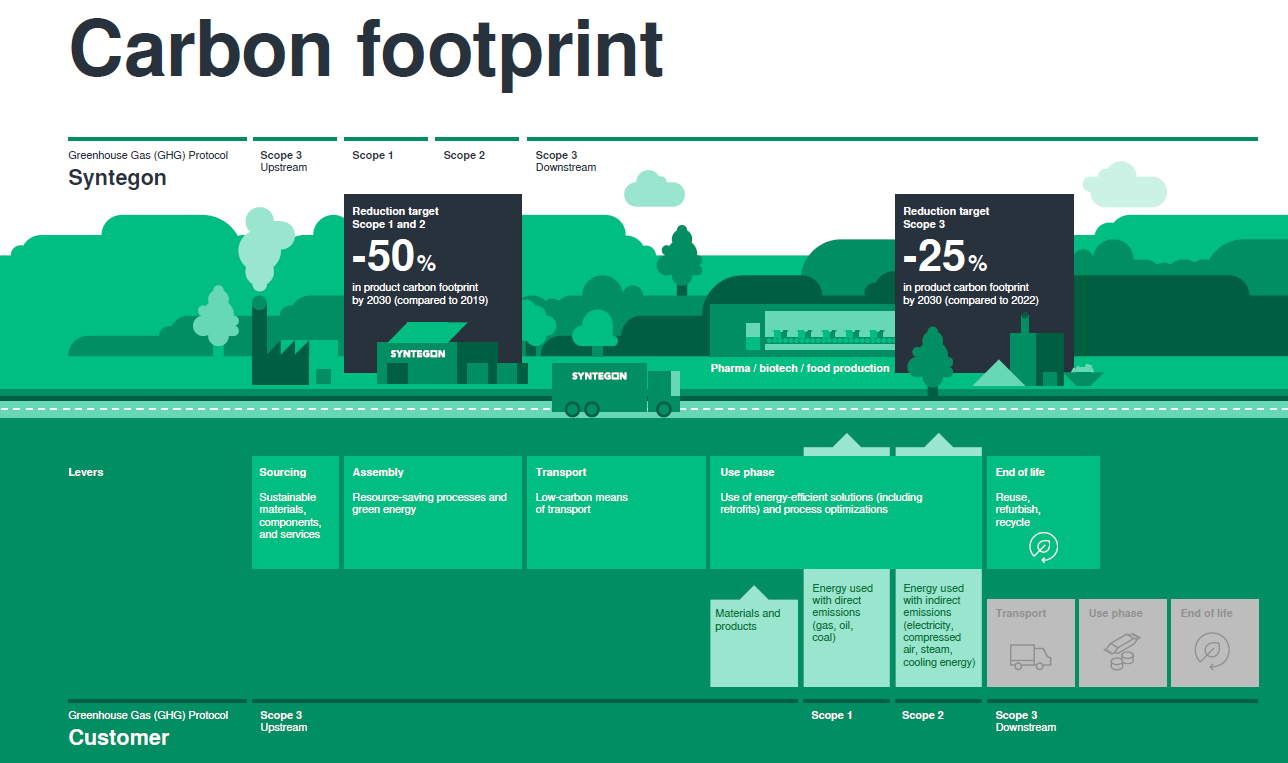
By 2030, Syntegon aims to reduce its Scope 1 and Scope 2 emissions – i.e. direct emissions from heating fuels and indirect emissions from purchased energy such as electricity – by 50 percent compared to 2019. The target for Scope 3 is particularly ambitious: emissions from purchased goods and the use of machines at customer sites are to be reduced by 25 percent compared to 2022. Since Scope 3 accounts for a significant portion of the total carbon footprint, it holds the greatest potential for savings – and at the same time offers a significant advantage for customers regarding their own sustainability goals.
Lower emissions directly result in lower energy costs – without the need for compensation through certificates. Instead, Syntegon invests in technological innovations that cut energy use directly at the customers’ sites, contributing to their sustainability strategy.
Less water = less energy consumption
A practical example of this approach is the HWBV sterilizer technology (hot water sprinkling process), which pharmaceutical manufacturers use to sterilize plastic or glass containers such as vials or ampoules. The process is energy-intensive: water is typically heated to around 120 degrees Celsius, sprayed over the containers, and then cooled down again. Thanks to targeted adjustments, customers can now save energy, water, and operating costs when using the HWBV sterilizer.
The principle is as simple as it is effective: less water means less energy consumption – and therefore lower emissions. By reducing the volume flow of process water in the pumps, the system requires less electric energy. At the same time, newly designed distribution and product trays optimize the film coverage on the containers, which improves heat transfer.
“By precisely adjusting the process water flow, we have significantly increased energy efficiency without compromising on performance.”
Gerold Macheiner, Product Development at SBM Schoeller-Bleckmann Medizintechnik, a Syntegon company
Circulation water typically accounts for 40 percent of the energy balance of the entire process, so any savings here have a direct impact on its carbon footprint. Using less water – and using it more efficiently – in turn allows for smaller pumps, heat exchangers and pipes, which results in additional reductions and, in some cases, even shorter process times.
Thanks to advanced simulation methods (CFD) and extensive testing, the various technical optimizations yield impressive results: customers can reduce the process water consumption of their sterilizers by up to 20 percent, which translates into CO₂ savings and energy cost reductions of up to 10 percent. For companies with particularly ambitious sustainability goals, Syntegon also offers an energy recovery system that can reduce energy consumption by an additional 35 to 45 percent.
Building a low-emission future together
The SBTi validation shows that Syntegon not only sets itself ambitious goals, but also backs them with scientific measures, as a PhD thesis in collaboration with Graz University of Technology highlights: Elias Hashemian Nik analyzed the savings potential for water and energy consumption and laid the scientific foundation for the redesign of the HWBV sterilizer. However, the most important success factor is the close collaboration with customers.
Syntegon pursues a holistic approach to sustainability that goes far beyond its own carbon footprint. The company not only minimizes energy consumption with its own operations but also enables resource-efficient processes at customer sites. After all, real emission reductions are achieved when everyone works together to put them into practice.
“Sustainability only becomes truly effective when technology providers and users work closely together. Our customers contribute their share, for example by switching to green electricity. We provide the right tools to help them achieve their emission reduction goals.”
Steffen Carbon, Coordinator for development methods at Syntegon
Syntegon Newsletter
Get inspired with regular updates on technologies and services, case studies, webinar offers and events.