

Identifying potential savings is like finding the proverbial needle in a haystack: it isn’t easy, but it isn’t impossible either.
With a concise analysis, Syntegon created transparency regarding energy consumption and CO2 emissions at the pharmaceutical Contract Development and Manufacturing Organization (CDMO) Siegfried and comprehensively tested its methodology in practice.
Companies in the pharmaceutical and food industries produce for different markets but pursue one overarching goal: both sectors are increasingly aiming for resource efficiency and ecological processes. However, if technological and process-related adjustments are to succeed, companies need another important resource that is far less obvious than the systems and products themselves – data.
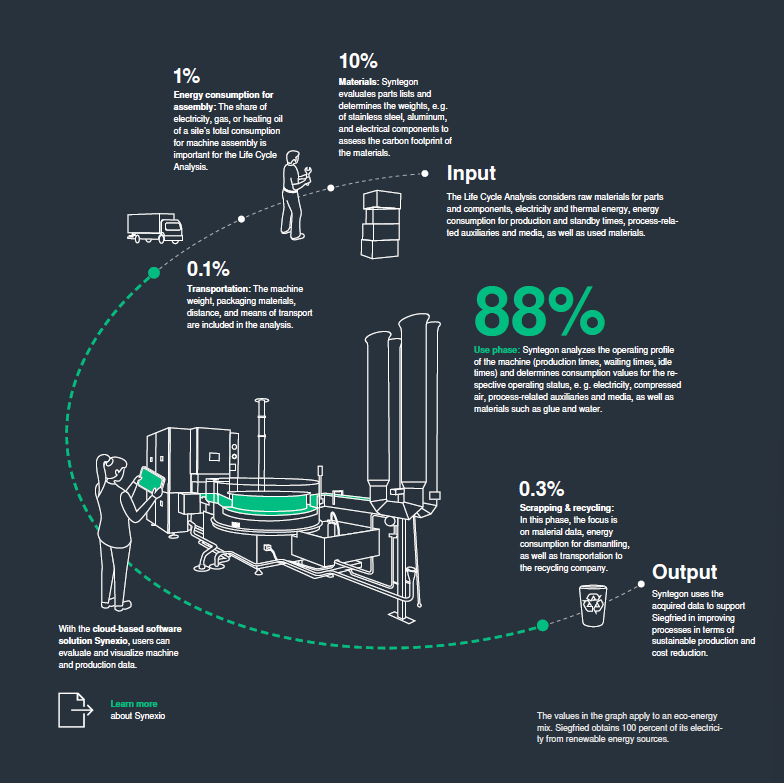
Siegfried AG, a pharmaceutical contract manufacturer based in Switzerland and with production sites in Germany, has focused on this resource and joined forces with Syntegon. The experts for processing and packaging technology developed their own calculation model based on so-called Life Cycle Assessments (LCA) and certified by TÜV Rheinland, a German association for technical inspection. The method allows the company to evaluate energy consumption and emissions during the entire life cycle of the machines from Syntegon’s portfolio.
Insightful findings
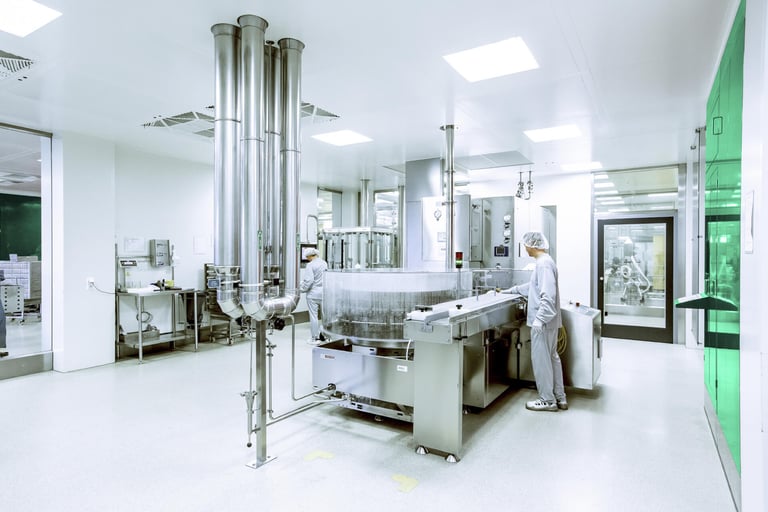
“Siegfried wanted to determine emission savings associated with green energy,” says Steffen Carbon, coordinator for development methods at Syntegon. “The company was also eager to understand the effects of modified production processes on the overall emissions at their German site.” Siegfried uses certified electricity from renewable energy sources to ensure the ecological operation of its filling lines. Moreover, a nearby waste incineration plant provides steam to produce water for injection (WFI).
“The company didnʼt know exactly how these adjustments would affect its emissions. Our analysis provided transparency, especially as all the machines on site are from the vast Syntegon portfolio,” Steffen Carbon points out. The LCA showed that by using green electricity, self-generated steam, and energy-efficient compressors to generate compressed air, the CDMO reduces its CO2 emissions by up to 80 percent, depending on the batch.
“Our analysis provided transparency, especially as all the machines on site are from the vast Syntegon portfolio.” Steffen Carbon, coordinator for development methods at Syntegon
A second calculation focused on the effects of modified production processes on CO₂ emissions. Instead of running several individual batches, the CDMO relies on so-called campaign filling, i. e. several batches in combination. The evaluation of the average times for individual and campaign batches reveals that Siegfried saves up to 20 percent in emissions during campaign operation. “Significantly reduced format changes and the one-off setting for campaign filling do the trick,” says Steffen Carbon, adding: “The LCA is not an end in itself but offers important guidance that companies can take into account when carefully planning and fulfilling regulatory requirements.”
“The LCA is not an end in itself but offers important guidance that companies can take into account when carefully planning and fulfilling regulatory requirements.” Steffen Carbon, coordinator for development methods at Syntegon
Syntegon Newsletter
Get inspired with regular updates on technologies and services, case studies, webinar offers and events.